


- Home
- Company Spotlights
- The Easiest Way to Lose a Crew
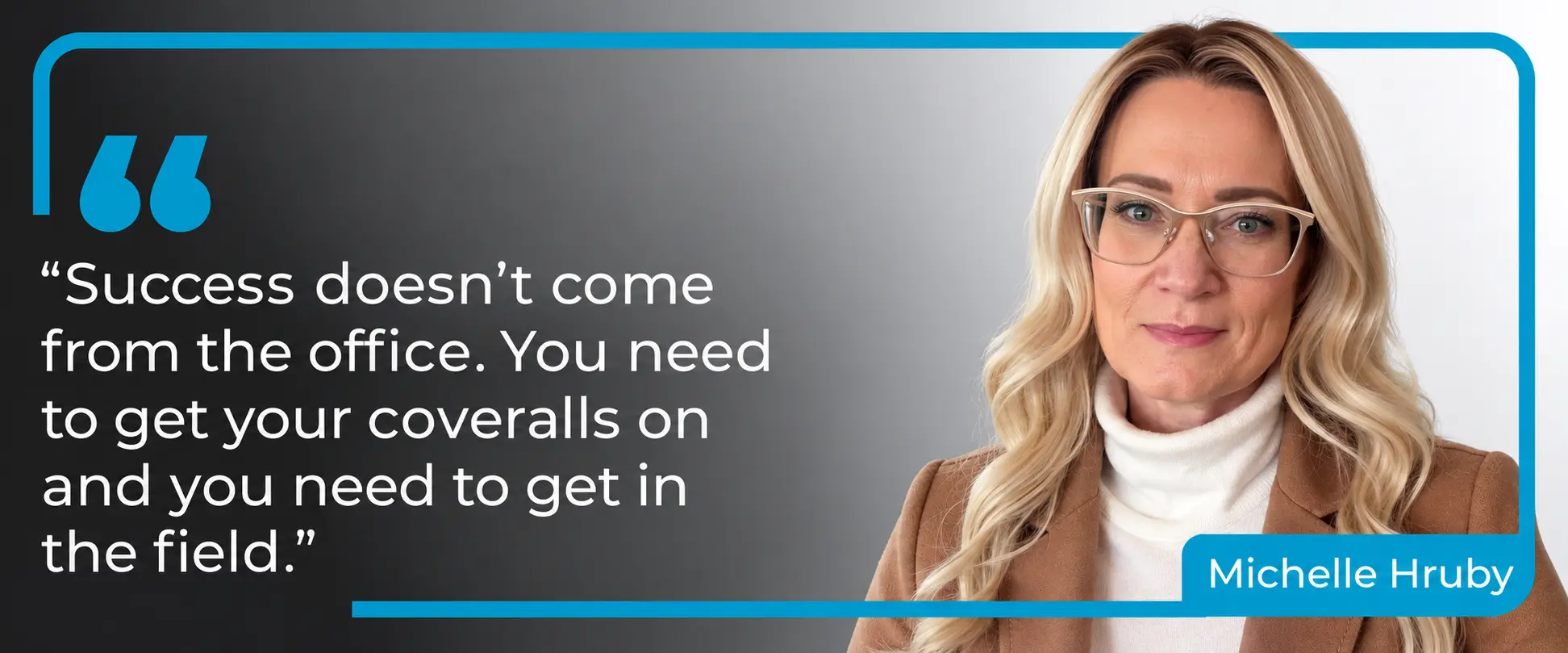
Michelle Hruby on the trap that catches new safety professionals, and the conversations she refuses to avoid.
“Success doesn’t come from the office.”
In 2025, Canadian Occupational Safety named Michelle Hruby one of Canada’s Top Women in Safety. At the time she was Director of Safety at Conuma Resources, the steelmaking coal producer whose mines sit near Tumbler Ridge and Chetwynd in northeastern British Columbia. She got there without aiming for it. She joined Joy Global Canada more than a decade ago in a reception role, started helping the safety coordinator, and took the job when the coordinator left.
What followed was not a desk. After Komatsu bought Joy Global in 2017, a national safety coordinator role put her in the field full-time, travelling across Canada and the US on mining shovel builds, undeckings and drill assemblies. About five years of that, then a management job at Conuma’s Brule mine, then a promotion to director inside roughly a year. She has since moved into a safety manager role with another company. Ask where the expertise came from and she is blunt. “I learned everything I learned about safety was honestly through that hands-on field experience.”
Read the cold welcome
Early on she would get driven up to a site by a supervisor, and the visit was choreographed before she arrived. “They already called the site. They already told me I was going to be there,” she says. “So everybody stops working, right? They know safety’s showing up, so all work stops.” She was expected to do a quick walk around and get back in the truck.
And while she walked, the manager would sit and tap on the dashboard, waiting for her to be done so he could drive her away.
Most people would read that as contempt. Hruby read it as a question, and the questions she asked were about them rather than herself. Why did they want safety gone so fast, and why did they not want anyone walking the site and talking? “Are they used to getting hit with citations and penalties and, and, you know, somebody just talking at them instead of with them?”
She does not pretend it was comfortable. Starting out, she says, “you spend a lot of time almost being scared to go out there,” because the questions were coming and she could not yet answer them. Her way through was accepting that “failure is a part of growth,” and treating the crews who challenged her as the ones showing her where her gaps were.

Yes-person safety
Being unwelcome pushes new safety people somewhere specific, and Hruby names it precisely. You can fall into “yes, person-type safety where everything you get asked to do, you just jump, where you don’t want the confrontation.” A crew gets told to go ahead and do it their way, “even though you know it’s not the safest way.”
She went the other direction and made sure people knew it. “My folks that I worked with learned very early on that I will have those difficult conversations with them.” Sometimes the answer is no. “And if it means work stops until the next day, then it stops till the next day until it’s, you know, we have proper controls in place.”
That, she argues, is what earns you the room. “I think that ultimately breeds respect,” from management, supervisors and workers alike, because everyone in the conversation wants the same thing. “You don’t want that phone call at 3 AM.”
AI that asks better questions
Hruby is further into practical AI than most safety leaders, and specific about what it is for. She runs seven or eight platforms in her own time to learn how they work together, uses Copilot, and has been building Power BI dashboards for safety. She rejects the obvious use. “I don’t use it and I don’t recommend using it as, you know, you type in a question, it gives you an answer, and there you’re done.” Where it earns its place is inside an incident investigation. Feed it what the team has already established, then use it to surface the questions nobody thought to ask. “You can ask AI different questions to prompt you in order to get a better investigation.” She calls that “a level of investigating that we never had before,” and thinks it matters most for people who do not yet know what to ask.
Somebody is always watching
The advice that stuck came in her first week, on a staircase, laptop in one hand and coffee in the other and no hand on the rail. Her regional manager was behind her. He stopped her and told her that somebody somewhere is always watching everything you do, even the small things. Wheel chocks, a walk around the vehicle, three points of contact on a ladder: she was to do it by the procedure even when she was the only person there.
“Always, every time,” she says. “And that piece of advice took with me my entire career so far.”
That is the other half of the bargain she made with the man drumming his fingers on the dashboard. Nobody is pleased to see safety pull up. The only thing that shifts it is being the same person every time, watched or not. “I’m consistent. I do the same things all the time. People know what to expect.”