
- Home
- Company Spotlights
- Private Investigator to Safety Leader
Why a former investigator stopped looking for blame and started selling the fix.
“We actually listen and we care. We don’t just judge and walk away.”
Before Cynthia Konkin spent her days keeping people safe, she spent years investigating them. She worked as a private investigator, in law enforcement, and after a while she “started to see only the bad side of things.” So, she figured, there had to be a good side too. She was also deeply into her own health, a competitive bodybuilder and a certified reflexologist, iridologist, and herbologist, and she went looking for a field that could hold both halves of her at once. The research kept landing on the same answer: health and safety.
So she went back to school at BCIT, “at an older age,” and was fortunate enough to start her career at the environmental engineering firm Golder Associates, where everything she had studied finally had somewhere to go. More than twenty years later, Konkin holds a degree in occupational health and safety and her CRSP, the benchmark Canadian certification, and has led safety for Canadian and North American operations across utilities, manufacturing, and just about every industry she could get her hands on. She chased that range on purpose, so that when someone asks her a question today, the answer is usually some version of “yeah, I’ve done that.”
Early on, a chiropractor introduced her to Eldeen Pozniak, the Saskatchewan-based founder of Pozniak Safety Associates and a past president of the Canadian Society of Safety Engineering. Konkin walked the floor of a safety conference that day with her head spinning, and left knowing what she wanted to do. The two still call each other to this day, about work, health, and family, and that closeness, she says, is exactly what she found in the safety field. “We’re all friends and we all look out for each other.” Ask her where the drive comes from and she keeps it plain. “I just care,” she says. “I have this overall caring.”
Safety is a hard sell
Two decades in, across all those industries, Konkin has landed on a blunt truth. “Safety is a really hard sell,” she says, “in no matter what environment.” The hazards repeat and the fundamentals hold, but the way you move people changes every time, and she learned not to walk in waving the rulebook. Lead with the law and “right away the barriers go up.”
Instead she uses the KISS principle, in her words, “keep it simple, Sam.” She starts with the people who actually do the job, takes their feedback up to the managers, and builds the change together rather than handing it down. Her current role, as Senior QESH Manager at Oerlikon, gives a small, perfect example. The company is moving its safety glasses from a seven-dollar pair to a two-hundred-dollar pair, and that jump is hers to sell. Her move is to let the workers pick the glasses themselves through a survey, because people wear and look after the gear they chose. For leadership, the math is just as simple: spend a little now, or pay for the eye injury later. “Take this little step right now,” she says, “and then the culture will change quickly.”
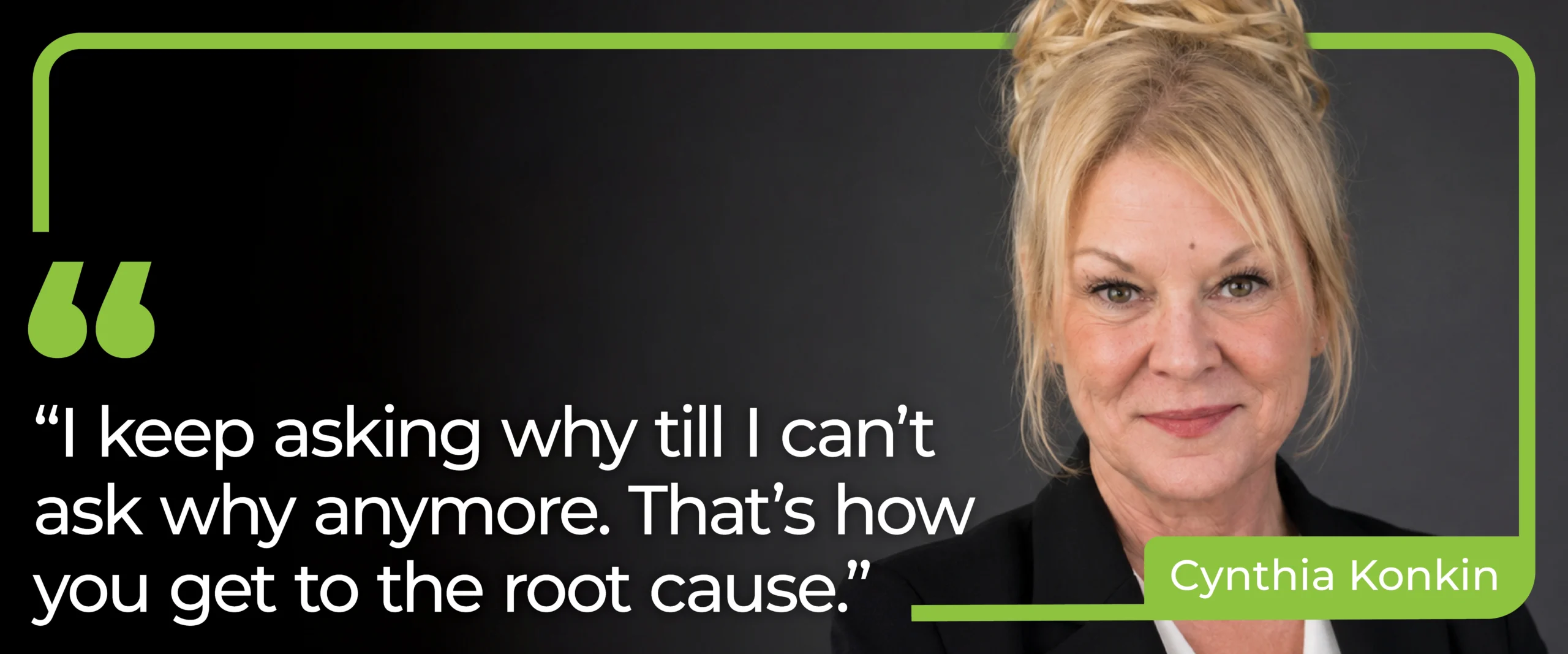
Underneath all of it sits one habit she traces straight back to her investigator days. “I keep asking why till I can’t ask why anymore,” she says. “That’s how you get to the root cause.” Every proposal, the way she sees it, is a case you have to build. “You build a case for everything.”

Play stupid, and say thank you
One of Konkin’s secrets for winning over a wary floor is to make herself the student. “You play stupid,” she says. She walks up to a worker and asks them to show her what they do, to teach her, and then she thanks them and means it. “In the field, people do not get the thank you,” she says, “and that’s what they want from senior leadership.” She can watch it work in real time: the arms uncross, and a small reluctant smile tells her the sale is quietly being made.
She has seen the reverse just as plainly. At one plant she hired a safety officer who lasted less than two weeks. He went straight to the floor pointing fingers, telling people it was the law and they could go to jail. “Everything I had built at that plant dissolved right in front of my eyes,” she says. The lesson held: an excellent safety professional has to be optimistic, patient, and always learning, and above all, “a people person,” not “a safety cop.”
The great program that wasn't
The work she is proudest of started with a company sure its safety program was already strong. That was Sun Gro Horticulture, where she spent five years as Corporate Director of HSE, responsible for safety across 32 facilities and peat bogs in Canada and the United States. They hired her to run a gap analysis and confirm it. “We’ve got a great safety program,” they told her. It wasn’t. Some of the elements didn’t even meet Canadian requirements, and the company ran on both sides of the border, so she had to rebuild the whole thing to satisfy OSHA and every Canadian jurisdiction at once, knowing California, Oregon, and each province carried its own rules.
Then came the part she had learned to expect. She had to sell it. She built her case to senior leadership, won the room, and rolled the program into the field by handing pieces of it to the managers who had been most resistant. The one with mining experience got to lead lockout/tagout. Over five years she built a team of four direct reports and watched safety move from “a paper exercise” to something the sites welcomed. As she puts it, they were “looking forward to Cynthia coming to their sites.” That was, in her words, “my baby.” Her team still runs it. “They’ll continue my legacy.”
The 24-hour rule
The hardest lessons, it turns out, were never about the programs. They were about her. Konkin wears her heart on her sleeve, and early on she carried every setback home with her. She had to learn to sit on her temper, too. Fire off one angry email, she says, and “my respect dropped. Right away.” Now she keeps a 24-hour rule. Unless the place is on fire, she waits, cools down, and sends it tomorrow.
She holds herself to the same standard she asks of everyone else. When she gets something wrong, “you apologize and say, yes, it was my mistake. I’m sorry, and then you move on.” What she cannot stand is blame. The investigator in her would rather find the root cause and fix the gap than decide who to fault. “We all make mistakes,” she says. “And if you tell me you don’t, you’re lying to me.”
Asked how she wants to be remembered, she doesn’t reach for titles. “As a people person who cared,” she says. “It didn’t matter who you are, if you’re the person that collects garbage or the CEO.” And asked what she would tell the woman who went back to school all those years ago, looking for the good side of things, she had the answer ready. “Cynthia, do not take things personally,” she says. “Get ready, girl. Yes, it’s going to be a fight and a challenge. But you know what? You’re strong. You can do it. And you’re going to do very well at it.”
She isn’t finished, either. “I’m not done,” she says. The next goal is to take her work global. The bigger one is closer to home: to be the kind of leader the next generation can come to and learn from, the way she once walked into a conference and found her whole life waiting.
For more conversations like this one, follow the Safety Spotlight podcast and newsletter, and connect with BIS Safety Software on LinkedIn.

