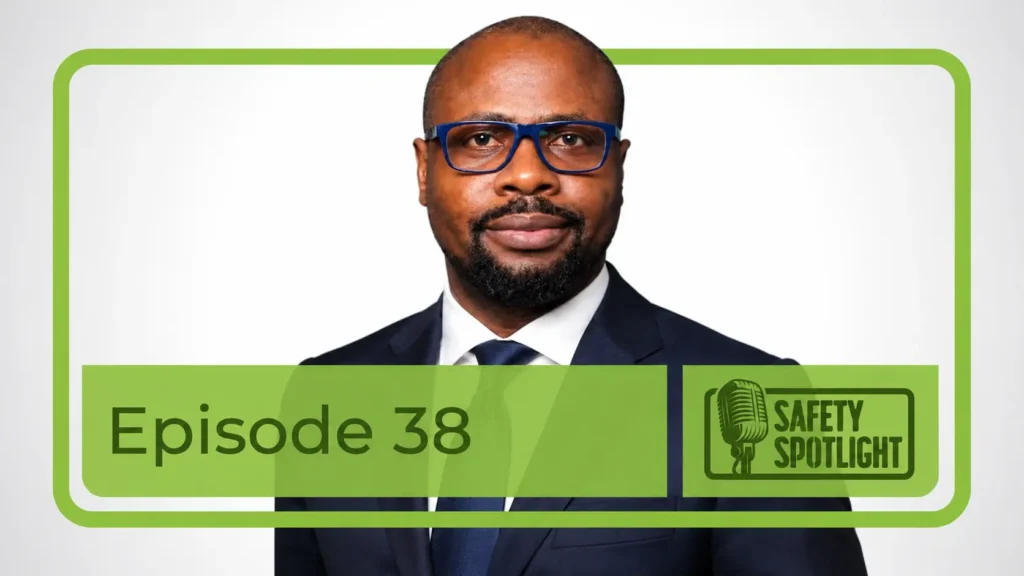
What do you do when an investigation you ran was thorough, detailed, and well received by leadership, and eight months later the same facility trips again on a different shift?
In this episode of the Safety Spotlight Podcast, we sit down with Michael Bassey, D.Eng, CSP, Asset Process Safety Advisor at Chevron and author of Beyond Blame: A Human and Organizational Performance Approach to Incident Investigation, Learning, and Leadership, to look at what incident investigations miss when they stop at human error.
Michael’s route into process safety ran through a classroom. He taught physics and advanced mathematics in Nigeria before starting in the field as a cementer, and in the two decades since he has worked across Nigeria, Qatar, the UAE, Argentina and North America, leading high-risk, high-consequence investigations through drilling, commissioning and turnarounds. He holds a Doctor of Engineering from George Washington University, carries a CSP, and describes himself first as a systems thinker.
This conversation breaks down:
– Why calling human error a root cause ends the investigation before it reaches the real problem
– What happened at a processing facility in 2010, and what the repeat incident eight months later revealed about the first report
– Why culture is the soil that behaviour grows in, and why that puts leaders on the hook for it
– How trust erodes over small unkept promises, including a door handle nobody got around to fixing
– Why operational discipline applies to leaders before it applies to anyone on the front line
– How behaviour observation programs drift into compliance exercises, and what Michael’s organization moved to instead
– What to look for in a mentor, and why a network of safety professionals is worth as much as the credential
Michael’s argument is that accountability and blame are not the same thing, and that treating them as interchangeable is what keeps organizations stuck. People make mistakes. The question is whether the system was built to absorb them, and whether leaders held to the standards they set for everyone else. He walks through the connection directly, from a meeting that starts fifteen minutes late without an apology, to the PPE that stops going on properly downstairs, to the investigation that writes it all up as a frontline failure.
You will also hear why he thinks he waited too long to look for a mentor, and what a supervisor did for him early on that he still points to. Before Michael started his role, that supervisor sent him around every facility in the business unit for two months, not to learn the work, but to meet the people. He also names the one thing he would do differently across his whole career, and it is not what most people say.
If you lead investigations, work in process safety, or are trying to understand what human and organizational performance actually looks like when it lands in the field, this episode delivers.
Michael’s book, Beyond Blame: A Human and Organizational Performance Approach to Incident Investigation, Learning, and Leadership, is available on Amazon.