- Home
- Company Spotlights
- Simon Wiederkehr and the People-First System
Simon Wiederkehr and the People-First System
Winter has a way of sharpening everything. Roads get slick, daylight disappears early, and patience wears thin by the week. In Alberta, that shift does not just change commutes. It changes the way risk shows up on the job. When the pace stays high and conditions get harder, safety stops being a policy and becomes a test of judgement.
That is exactly where Simon Wiederkehr’s style of safety leadership takes shape. At FourQuest Energy, it shows up not in perfect conditions or perfect paperwork, but in real-world constraints, long shifts, tight timelines, and crews who are tired, far from home, and expected to perform.
That is where Simon Wiederkehr’s approach to safety stands apart.
From Operator to Safety Lead: Credibility Earned Through Experience
Safety lands differently when it comes from someone who has done the work. Simon came up through the ranks as an oil and gas operator, then moved into safety after an Achilles injury forced him off the shop floor and into a role beside the safety lead. What started as a temporary assignment became a fast promotion, then a trial-by-fire career built on learning, problem-solving, and finding good people to learn from.
That operator background matters for one reason. It creates instant realism.
People listen differently when safety guidance comes from someone who has done the job, understood the process, and known the shortcuts that appear when nobody is watching. Simon’s operator background allows him to spot those shortcuts early, not with suspicion, but with realism.
That credibility cannot be taught in a manual. It is about pattern recognition.

Safety Is About People, Not Manuals
One quote drives Simon’s entire approach:
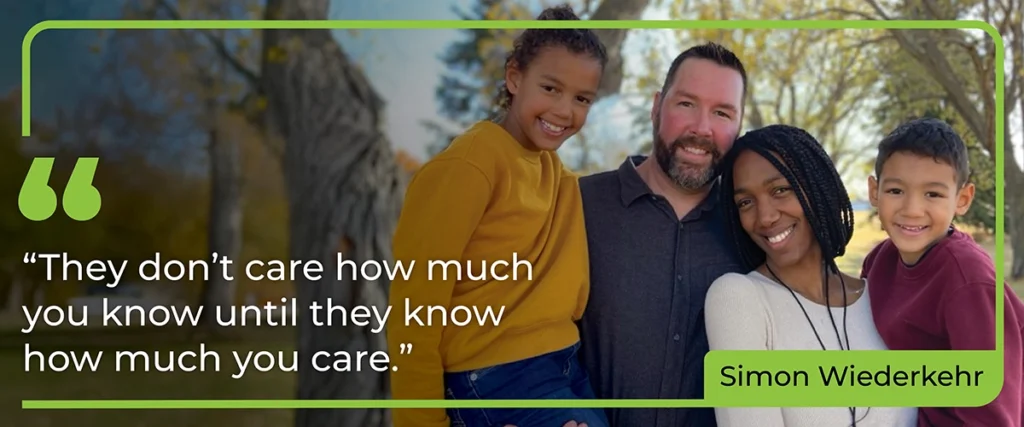
“They don’t care how much you know until they know how much you care.”
This is not a motivational slogan. It is a psychological truth.
People disengage when safety systems feel imposed rather than shared. When safety shows up as rules without context, eyes glaze over. When safety shows up as genuine concern for the person doing the work, conversations open.
Simon leads people first. He walks to sites and talks to workers about more than tasks. Family. Home. Fatigue. How long they have been on shift. Those conversations are not distractions, they are intelligence gathering.
Psychologically, this builds trust and reciprocity. When people feel respected, they are far more willing to share the truth, including the uncomfortable truth about what is really happening on the worksite. Simon uses that daily by walking sites, talking to workers about life, and letting real risk surface naturally.
That is how the hidden hazards come to light before they become incidents.
Why Common Sense Is Not Enough Anymore
Simon often points out a hard reality. Common sense is not guaranteed.
Experience levels across today’s workforce vary widely. Some workers arrive with strong problem-solving instincts built through hands-on environments like farms or trades. Others arrive with strong technical knowledge but limited exposure to unpredictable, high-risk conditions.
Safety leadership bridges that gap by making thinking visible.
Rather than lecturing from a manual, Simon reframes safety concepts in ways people already understand. A field-level risk assessment is not an abstract form. It is the same mental process people use when picking up a hot cup of coffee, stepping onto ice, or carrying something awkward through a doorway.
By connecting safety processes to everyday decision-making, resistance drops. The work becomes relatable. Writing it down before a complex task no longer feels like bureaucracy, it feels like preparation.
Industrial Tank Cleaning, Where Systems and People Are Tested
Industrial tank cleaning safety is not a generic hazard profile. This work stacks multiple high-consequence risks in one place:
- confined space entry and restricted access
- flammables and hydrocarbons
- atmospheric hazards and gas monitoring
- ignition control, grounding, and static risk
- chemical exposure and protective suit selection
- heat stress inside a steel tank, especially in summer
- rescue complexity if something goes wrong
Federal guidance on confined spaces in Canada outlines why these spaces are high-risk, enclosed, not designed for continuous occupancy, with restricted entry or configurations that complicate rescue. CCOHS also emphasizes that an entry permit is used to document hazard identification and risk assessment for each confined space entry.
In Alberta, OHS Code Part 5 requires employers to maintain a confined space code of practice and outlines what must be in place before workers enter a confined space.
That matters in industrial tank cleaning because much of the work takes place in confined spaces, with real safety obligations attached to every entry.
Developing Real-World Competence Under Pressure
One of the most dangerous assumptions in safety is that training equals competence.
Simon’s approach rejects that idea entirely. Real competence is built in context, under real conditions, with feedback that is immediate and practical.
New workers are supported through mentorship and observation. Processes are explained in the field, not just in a classroom. Decisions are discussed while tasks are happening, not only after something goes wrong.
This moves learning beyond memorization. Workers are asked to analyze hazards, evaluate conditions, and apply controls in real time. That is how judgement survives long shifts and difficult environments.
When Humour Builds Honesty and Honesty Prevents Incidents
Safety conversations often fail because they begin with confrontation.
Simon uses humour as an entry point, not to minimize risk, but to lower defensiveness. When a worker offers a questionable explanation, an experienced safety leader can challenge it without escalating conflict.
This approach aligns with a core principle of behaviour change. People correct behaviour more effectively when they feel respected rather than threatened.
When honesty feels safe, unsafe practices surface sooner. That timing matters.
Mental Capacity Is a Leading Indicator
One of the strongest signals Simon watches for on-site is not physical technique, but mental capacity.
Long rotations. Extended time away from family. Heat stress inside protective suits. Fatigue from repetitive, high-focus tasks. These factors quietly erode attention long before an incident occurs.
By talking with workers regularly and paying attention to how they are coping, Simon identifies risk early. Sometimes the control is as simple as slowing the pace, rotating tasks, or checking in more often.
Safety systems that ignore mental load miss the warning signs that come before failure.
Results Follow Culture, Not the Other Way Around
FourQuest’s industrial tank cleaning division has grown from roughly one tank cleaning project per year to four in the most recent year, becoming a primary provider for a major oil and gas company.
That growth did not come from shortcuts. It came from people.
Simon credits the company’s success in its atmosphere. Despite being a global organization, it feels like family. That culture encourages communication, accountability, and pride in the work.
When people feel supported, they protect the system. That protection shows up in safer decisions, stronger teamwork, and consistent performance under pressure.

What Safety Leaders Can Take from This Approach
Simon Wiederkehr’s safety leadership is not flashy. It is disciplined, human-centered, and effective.
- We lead with care, then enforce standards
- We build credibility through real work experience
- We translate safety concepts into everyday thinking
- We use humour to open conversations, not avoid accountability
- We monitor mental capacity, not just task completion
- We design systems that people trust enough to protect
That is what people-first safety looks like in the real world, especially in high-risk environments where conditions are rarely ideal, and mistakes carry weight.
When safety works here, it works anywhere.
Related Articles

Discover Brian’s approach to workplace safety, from identifying hazards and documenting risks to building practical competence and learning from real-life...

Jason Ross of Bird Construction shares how a panic attack on a winter highway in northern Manitoba led him to...

Garrett Hill shares why crews take in the safety message once they know the person delivering it, and what ten...