
- Home
- Company Spotlights
- Shilo Neveu on Leading with Trust, Transparency, and Calmness Under Pressure
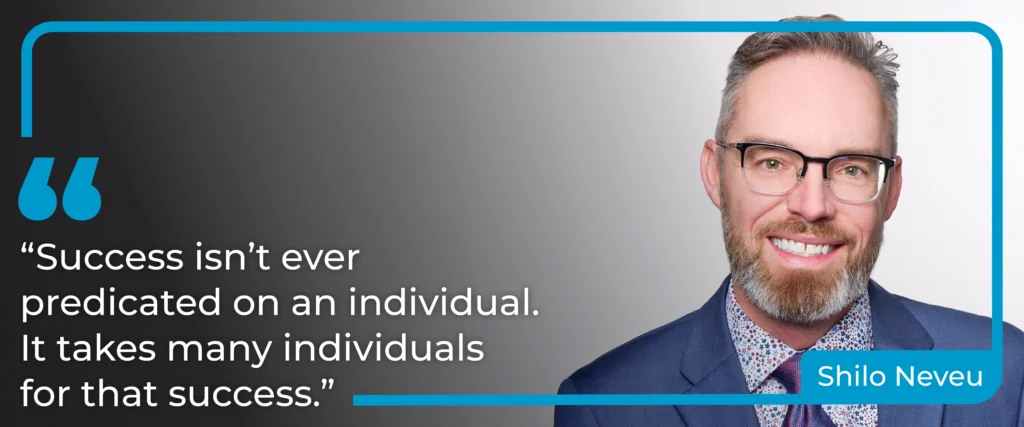
Shilo Neveu’s view of leadership is grounded in a place many people forget: what you do when there’s no audience.
He talks about trust, consistency, and emotional control in a way that feels less like theory and more like a set of repeatable behaviours you can practice on a jobsite, in an office, or in a tense meeting.
Shilo’s career has moved through three demanding worlds, each one sharpening a different part of his approach. He began in construction and environmental work, spent a decade practicing law with a focus on occupational health and safety, and later transitioned into executive leadership. He has been with Valard for nine years and has served as EVP since 2018.
What connects those chapters is not job titles. It’s how he thinks: stay clear on the facts, treat people with respect, and lead the same way whether you’re “on stage” or not.
Field Experience First, Then Learning Safety the Hard Way
Early in his career, Shilo worked at PCL Construction as a field advisor on commercial projects, including large-scale work across Canada. In those environments, safety is never abstract. It is a daily negotiation between schedule pressure, complexity, and human decision-making.
That field experience made his later legal work more impactful. When Shilo moved into law, he supported companies dealing with serious incidents, regulatory involvement, and court processes. He described it plainly: in that setting, you learn fast that outcomes depend on evidence, facts, and how quickly teams can align on the facts.
His preference is simple: put the cards on the table early. Then focus the conversation on what to do next.
Leadership Built on Mentorship, Not Ego
Shilo is unusually direct about how much other people shaped his path.
Early in his career, a mentor encouraged him to pursue law, even though Shilo had no desire to return to school and did not see himself as “academic.” He chose a practical route, making decisions based on affordability and real-world outcomes, not prestige.
That practicality fits with his roots. Shilo described growing up in a blue-collar family and being comfortable around tradespeople and operations. It shaped how he communicates, how he connects, and how he leads.
One thing that stood out is his refusal to “perform” professionalism. He would rather be understood than sound polished.
Second-Generation Safety and the Importance of Earning Credibility
Shilo calls himself a second-generation safety professional, influenced heavily by his dad’s career in safety. There’s a sense of generational continuity in his story: jobsite exposure as a kid, respect for craft professionals, and dinner-table conversations that drift toward operations and safety.
But he also shared a key point that matters for any leader with strong connections: credibility still must be earned. Shilo intentionally built his own name early, choosing opportunities where he wouldn’t be seen through someone else’s reputation. Later, when the connection became obvious, he knew he had done it the right way, because the team’s instinct was to see his dad as “Shilo’s dad,” not the other way around.
In safety, people do not follow a resume. They follow consistency.
Trust Across the Organization, From Executives to Crews
When Shilo talks about trust, he gives you two behaviors that translate cleanly into real work.
Transparency
His version of transparency is not “being nice.” It’s clear. He wants everyone to solve the same problem from the same facts. He described putting everything on the desk, good or bad, so the team can stop guessing and start deciding. He also tied this directly to psychological safety: a space where people can be honest without fear is a space where you get better information.
Positive intent
Shilo starts conversations by assuming people mean well, unless their actions prove otherwise. That assumption reduces defensiveness and makes it easier to hear the real message behind someone’s delivery. It also changes the temperature of conflict. When a leader stays open instead of reactive, tense conversations become more solvable.

The Hidden Leadership Move: Emotional Transitions
A practical skill Shilo emphasized is what happens between conversations.
Leaders often finish a heated meeting and then immediately interact with someone who needs help. If the leader carries frustration into that next interaction, the person asking for help receives the wrong emotional “signal” and may stop sharing issues altogether.
Shilo tries to reset quickly. He focuses on being welcoming and present, even if the last call was rough. In safety culture, those micro-moments matter. They shape whether problems surface early or stay hidden.
Consistency: Are You the Same “On Stage” and “Off Stage”?
Shilo uses the idea of a “stage” to explain why some leaders feel unpredictable.
People can hold a polished persona for a while. But maintaining it takes energy. Eventually the mask slips, and the team gets a sharper reaction than they expected. When workers and supervisors don’t know which version of a leader is going to show up, they hedge. They delay. They avoid it. They share less.
His recommendation is to lead yourself and improve yourself, rather than trying to perform a leadership character. Consistency is a trust builder.
The Simplest Philosophy That Still Works
Shilo’s off-the-cuff leadership guidance is intentionally plain:
- Do the right thing even when you think nobody is watching.
He backs it up with examples that land instantly: returning a shopping cart, holding an elevator door, and the many small moments where character shows up without enforcement.
This is why it matters for safety leadership: if you only do the right thing when there’s a supervisor present, safety becomes a performance. If you do it consistently, safety becomes a culture.
Advice for New Safety Professionals: Care Deeply, but Don’t Carry Everything
Shilo’s message for early-career safety professionals is a reality check and a protective strategy.
Safety can be a thankless career. You will see people get hurt, and you cannot treat every outcome as proof you failed. If you personalize every incident, you will either burn out or become jaded.
His solution is separation, not coldness. You can care about people and still maintain the clarity needed to respond effectively. In serious incidents, teams look to safety leadership for the next step. If you escalate, the entire situation escalates with you. If you stay calm, people stabilize faster.
Calm is Trainable, and it Starts with Self-Awareness
Shilo believes emotional control is learned. He described how self-awareness works in the real world:
- Know what triggers you.
- Notice the first physical or mental signal that you’re escalating.
- Acknowledge the emotion instead of suppressing it.
- Set it aside temporarily so you can deal with what’s in front of you.
- Come back to it later when processing is appropriate.
This is not “ignore feelings.” It’s chosen timing so your feelings don’t choose your behavior for you.
Related Articles

Discover Brian’s approach to workplace safety, from identifying hazards and documenting risks to building practical competence and learning from real-life...

Jason Ross of Bird Construction shares how a panic attack on a winter highway in northern Manitoba led him to...

Garrett Hill shares why crews take in the safety message once they know the person delivering it, and what ten...