
- Home
- Company Spotlights
- Linda Feuerhelm’s Mission to Make Sure Everyone Gets Home Safe
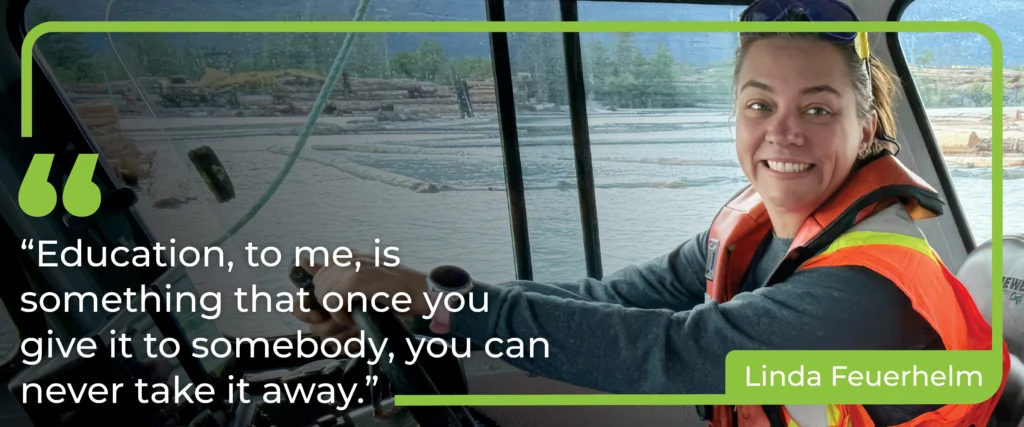
Some people work in safety because it is their job. Linda Feuerhelm works in safety because, for her, it has always been personal.
When Linda was 13, her father died in a head-on collision. He was the passenger in the vehicle. The woman driving survived, but the man in the other vehicle also lost his life. That loss changed everything.
Since then, safety has never been abstract for her. It has never been about paperwork, policy binders, or checking a compliance box. It has been about one thing: making sure no one else gets that knock on the door.
That mission still drives her today, including in her work as owner and founder of Brizo Marine Safety Services Ltd.
People who know Linda know she brings more than technical knowledge to the table. She brings urgency, heart, humour, and a deep sense of responsibility to the communities she serves. In small towns and close-knit industries, she says, tragedy does not stay contained in one household. It ripples through families, workplaces, and entire communities. That is why her approach to safety puts care first.
“People know I care,” she said. “I really want everyone to make it home safe.”
That care shows up in her teaching, her advocacy, and her fight for change.

The Go-To for Marine Regulation Confusion
If there is one area where colleagues consistently turn to Linda for help, it is the maze of marine regulation.
She has built a reputation as someone who can navigate the Canada Shipping Act and Transport Canada requirements, even when those rules seem to shift constantly. In an industry where regulations are dense, interconnected, and frequently updated, that skill has become a superpower.
As Linda explains it, the challenge is not just that the rules are complicated. It is that they are often inconsistently understood, even by the people responsible for enforcing them. One certificate has one requirement to obtain it, another has a different requirement to keep it valid, and many workers are left trying to piece the whole thing together through whispers, hearsay, outdated assumptions, and partial interpretations.
She has made it a point to stay on top of those changes, challenge unclear interpretations, and help others make sense of what actually applies.
For workers trying to get certified, employers trying to stay compliant, and trainers trying to prepare for the next generation, Linda has become a translator between regulation and reality. She does not just memorize rules. She interrogates them. She pushes back when something does not make sense. She expects regulators to fully understand and apply what they wrote. And she makes sure workers understand what those rules mean in practice.
That clarity is one of the many reasons people trust her.
A Teacher Who Knows How to Hold a Room
Part of Linda’s effectiveness as an educator comes from the fact that her path into safety was anything but conventional.
She grew up in Alberta. She bartended. She performed in stand-up comedy and was once named one of Vancouver’s top five funniest female comics. She worked in trucking and over-dimensional permitting. She studied broadcasting. She has stories for days and the timing to make people listen.
That background helps explain why her classes do not feel like traditional safety instruction.
She knows how to read a room. She knows how to keep attention. She knows that people remember a story long after they forget a slide deck. And she knows the power of the “aha” moment, that instant when someone finally understands something in a way that will stay with them.
For Linda, that moment is everything.
“One of my favourite things about training,” she said, “is that aha moment where it’s like, oh, you got it. I see you learned something. And you know at that point, when that light goes on, that it’s going to stay with them forever.”
That belief in education runs deep. She sees training not just as a job, but as a way of strengthening individuals, families, and communities. Once knowledge is given to someone, she says, it cannot be taken away. It can only benefit them and the people around them.
That is especially meaningful in northern and rural communities, where access to training can be limited, and the consequences of being underprepared can be severe.
Humour, Grit, and a Refusal to Look Away
Linda is serious about safety, but she is not solemn. Humour is part of how she connects, teaches, and keeps going.
That humour comes through often in conversation. So does her grit.
She tells stories about teaching fall protection in a bar after someone once joked that she would never do it. She talks about building companies and study guides while others question what she is doing. She describes herself as the kind of person who will run out of knuckles before backing down from a fight that matters.
And underneath the humour is something steady and unmistakable. Linda is motivated by service, not ego.
She is not trying to be famous. She is not trying to stand on a soapbox for the sake of it. She is trying to stop preventable loss. She is trying to make training accessible. She is trying to make workers feel seen, respected, and equipped to go home safely.
That is what gives her work its force.
She has seen what happens when systems fail. She has seen what exclusion does. She has seen what communities carry after tragedy. And she has decided, again and again, to turn that knowledge into action.
Leading With Care
When asked what her safety superpower is, Linda did not point to policy writing, auditing, or regulatory knowledge, though she has plenty of that too.
She pointed to care.
Real care is what pushes someone to ask harder questions, stay later, speak up louder, and keep fighting when change feels slow. Real care is what helps a worker trust an instructor. It is what helps a family know their loss matters. It is what makes a community believe someone is truly in its corner.
Linda Feuerhelm has built her career on that kind of care.
She brings personal experience, technical knowledge, fierce advocacy, and a teacher’s instinct to one of the toughest corners of workplace safety. She is helping shape safer marine operations, stronger education pathways, and more human approaches to training, especially in places that too often get left behind.
Most of all, she is reminding the rest of the industry what safety work is really about.
It is about people.
It is about access.
It is about dignity.
And it is about making sure more families get to keep the people they love.
Related Articles

Discover Brian’s approach to workplace safety, from identifying hazards and documenting risks to building practical competence and learning from real-life...

Jason Ross of Bird Construction shares how a panic attack on a winter highway in northern Manitoba led him to...

Garrett Hill shares why crews take in the safety message once they know the person delivering it, and what ten...