Free webinar, Nov 25: Practical AI in Safety with Ashley Mckie. Save your spot →

BIS Safety Software
Excavation and Trench Safety – CAN
Learn excavation and trench safety in this 60-minute online course for Canadian workplaces: the competent person, soil classification, trench failure warning signs, sloping, shoring and shielding, and atmospheric hazards. Earn a certificate when you pass.
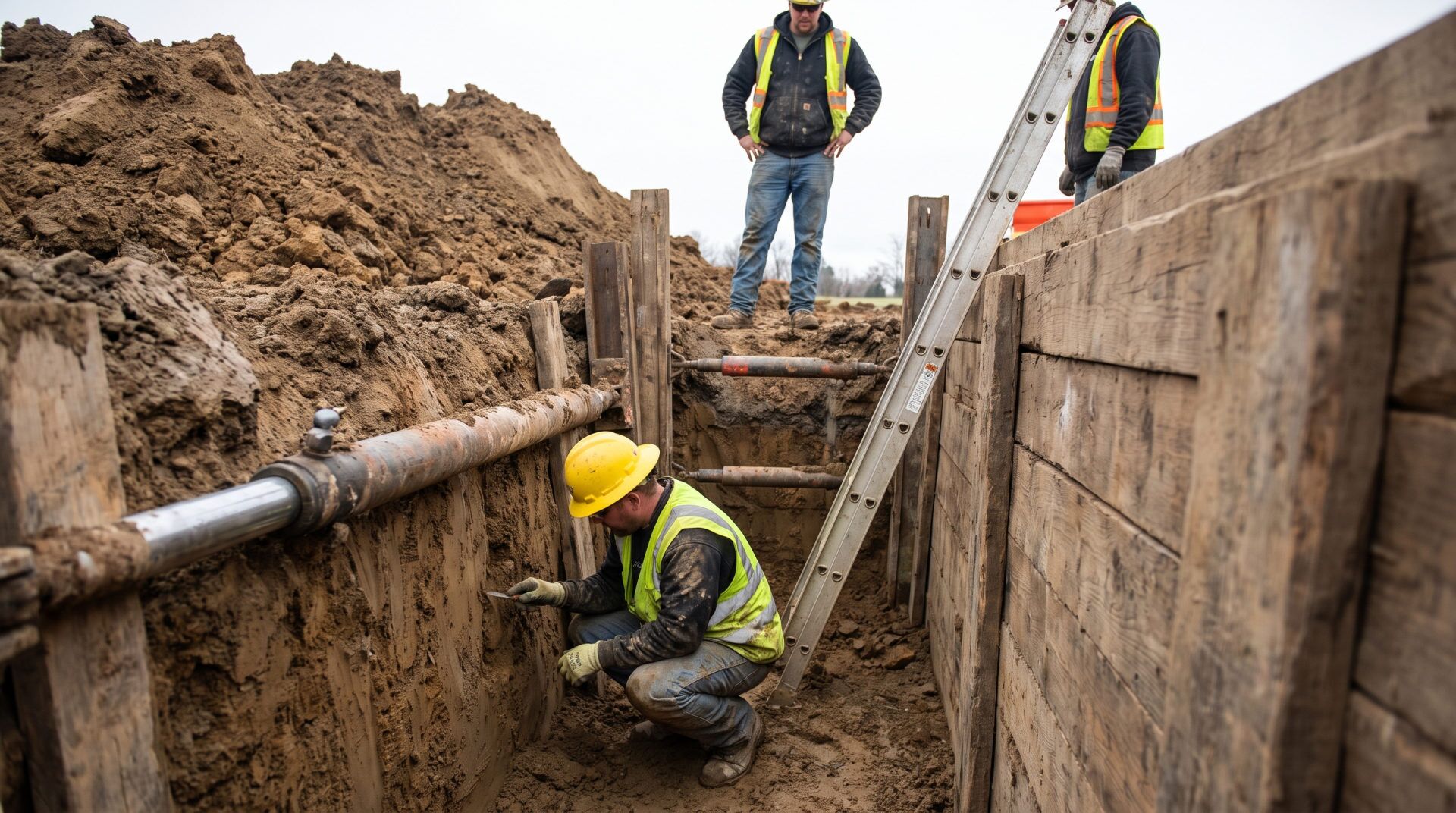
A trench wall does not announce its failure. Workers who enter excavations without excavation and trench safety training are less likely to read the ground accurately, classify the soil correctly, or select the right protective system before conditions deteriorate. This online course delivers the practical knowledge crews need to work safely below grade. You finish with a working command of soil behaviour, hazard recognition, and protective system selection, skills you apply on the next dig.
Course Overview
Excavation and trench safety training covers the full scope of below-grade hazards, from unstable ground conditions to invisible atmospheric risks. The course is built around learning modules that cover:
- Competency and the competent person role
- Soil types and classification methods
- Warning signs of trench failure
- Protective systems: sloping, shoring, and shielding
- Atmospheric hazards in excavations and control measures
- Common excavation accident patterns and how to prevent them
Each module builds on the previous one, moving from definitions through practical hazard control and toward a working picture of how excavation incidents develop and where to interrupt them.
The course closes with a knowledge assessment requiring 80% to pass, and a certificate of completion is issued the moment you do.
The course covers soil behaviour, atmospheric hazards, protective systems, and closes with a certificate assessment.
What You’ll Learn
This excavation and trench safety course covers the skills you need to assess a site, select a control, and act before conditions deteriorate.
Competency and the competent person role
- Describe what competency means specifically in the context of excavation work, so the term carries a precise, actionable definition on site.
- Describe the role and duties of a competent person, including what that individual is responsible for observing and acting on before and during excavation work.
Soil behaviour and ground conditions
- Identify and classify basic soil types using the characteristics that determine how a trench wall will behave under load.
- Recognize the warning signs of trench failure: tension cracks, boiling, sloughing, and other observable indicators before a collapse occurs.
Protective systems for trench work
- Describe the three types of protective systems used in excavation work and when each is appropriate for the actual ground conditions present.
- Apply the criteria that govern protective system selection to real excavation scenarios encountered on a Canadian construction site.
Atmospheric hazards in excavations
- Identify atmospheric hazards in excavations, including oxygen deficiency and toxic gas accumulation, and describe the control measures used to address each.
- Recognize the conditions that can make an excavation atmosphere dangerous and the monitoring steps that should precede entry.
Accident patterns and hazard recognition
- Recognize common excavation hazards and accident patterns so you can spot a developing problem before it becomes a fatality.
- Explore the sequence of events that leads to trench collapses and identify the intervention points where the right action breaks that sequence.
Assessment and completion
- Work through a final knowledge assessment requiring a score of 80% or higher to demonstrate command of the excavation and trench safety material covered.
- Demonstrate course completion with a certificate issued upon passing, providing a verifiable record of your trench safety training.
Who Should Take This Course?
- Construction workers entering excavations who want to recognize hazardous ground conditions and understand the protective systems around them before they descend.
- Competent persons and designated site leads who are responsible for inspecting excavations, classifying soil, and making go/no-go decisions before a crew enters.
- Site supervisors and foremen who oversee excavation crews and benefit from a documented basis for the safety decisions they make on the ground.
- Health and safety officers who audit excavation work, review protective system selection, and confirm that atmospheric hazard controls are addressed before entry.
- General contractors and project managers who carry accountability for site safety and need their teams trained to a consistent, verifiable standard.
- New entrants to the construction trades who will encounter excavation work and need a grounded command of trench hazards before their first dig.
Why Take This Course?
Trench collapses move faster than rescue. The weight of soil in a partial collapse can exceed what any rescue effort reverses in time. Prevention is the only reliable strategy, and it starts with what you know before you step in.
The gap between a worker told to stay out of an unsafe trench and one who independently identifies why it is unsafe is what this course closes. You learn the warning signs, the soil behaviour, and the protective system options, so compliance becomes active hazard control rather than a box-tick.
Atmospheric hazards give no visible warning. Oxygen-deficient and toxic-gas conditions are undetectable without the right knowledge and monitoring steps. You leave this course knowing what to test for and when to test it.
Documented training can support employers and crews when safety decisions are reviewed. A certificate of completion on file shows that protective system selection was taught, competent-person duties were communicated, and workers understood the hazards before entry.
Key Benefits
- Certificate of completion issued on passing. A shareable credential that records excavation and trench safety training for employer files, site documentation, and audit purposes.
- Collapse and atmospheric fatality risk addressed directly. You leave the course better equipped to act on visible warning signs and atmospheric hazard indicators before conditions deteriorate.
- Completed in 60 minutes, entirely online. No travel, no classroom booking, and no crew pulled off site for a full training day to address your excavation safety training needs.
- Soil classification and protective system knowledge built for field use. You learn a decision framework you apply to actual ground conditions on the next job, not a checklist that fades after the test.
- Priced at $99.99 per learner. A fixed, per-seat cost that lets employers plan a predictable training budget line for workers assigned to excavation and trench work.
Course Details
- Duration: 60 minutes
- Format: Online, self-paced
- Pass mark: 80%
- Certificate: Certificate of completion included
- Price: $99.99
- Locale: Canadian (en-CA)
Frequently Asked Questions
How long does the excavation and trench safety course take to complete?
The excavation and trench safety course runs for 60 minutes and is completed entirely online at your own pace.
What score do I need to pass the excavation and trench safety training?
You need 80% or higher to pass and receive the certificate of completion.
Is a certificate included with this excavation and trench safety course?
Yes, a certificate of completion is issued automatically once you pass the final assessment.
Who should take this excavation and trench safety course?
This course is built for construction workers, competent persons, site supervisors, health and safety officers, and anyone who works in or around excavations and trenches.
What does the course cover in terms of protective systems for trench work?
The course describes the three types of protective systems used in excavation work and explains the conditions under which each is the appropriate choice for the ground you are working in.
How much does the excavation and trench safety online course cost?
The course is priced at $99.99 per learner.
Enrol in the Excavation and Trench Safety course now and give your crew the knowledge to work safely below grade.
Course Details
Course Length
This course will take roughly 60 minutes
Passing Mark
To pass this training course, you need to score 80% or higher on the quiz
Certificate
Upon the successful completion of this course a certificate with your name will be stored on your profile and available to print
Additional Training Courses

ICC Shipping Lithium Batteries by Air (CA & US)
WB-LITGAU10R This course offers comprehensive knowledge about the regulations governing the transportation of lithium batteries as per the guidelines laid down by the IATA...
Hazard Communication (US)
This digital Hazard Communication course aims to provide comprehensive knowledge about the HazCom Standard, the Globally Harmonized System of Classification and Labelling of Chemicals...
GHS Container Labels
Our GHS Container Labeling e-course explores the six categories of information found on a GHS label, highlighting the distinctions between GHS labels and other...