
- Home
- Company Spotlights
- Chris Cole on Building Safety Programs That Scale Without Becoming “Safety Police”
Chris Cole did not set out to build a career in safety. Like many people in the field, he stepped in because the work needed to be done, and no one else was there to do it.
He started as a site supervisor. Then safety landed on his desk too, because the site needed it. That accidental entry point became a pattern. Chris kept being handed complex, high-stakes responsibilities, and he kept building systems that held up in the real world.
Today, at Cross Country Canada Supplies & Rentals, he manages safety across a multi-branch operation spanning Canada and the U.S., while also carrying quality responsibilities and supporting multiple business units. His approach is practical, scalable, and grounded in one core belief:
“Safety works best when people are not afraid to talk.”
Building a COR Safety Program from the Ground Up
Chris describes his start simply. A company needed a safety person, so he stepped into the role. The results, however, were far from simple.
After stepping into the safety function, he helped the company achieve COR certification in about six months, while also expanding his responsibilities into safety management and quality assurance quality control.
Strong safety leaders often see safety and quality as part of the same system. Chris made that connection early. Quality failures can lead to safety incidents, and weak safety practices almost always surface in quality or maintenance issues.
The Scale Problem: You Can’t Be in Nine Places at Once
As the company grew, the old safety workflow started breaking down.
Field Level Hazard Assessments (FLHAs) were being mailed in from different provinces. Those meant delays, gaps, and a lack of visibility. Chris needed a way to confirm whether crews were actually doing the work: hazard assessments, pre-trip inspections, and preventative maintenance checks.
His turning point was shifting from “collecting paperwork” to “getting visibility.”
That’s where digital workflows became a force multiplier, not because technology replaces leadership, but because it makes leadership possible at scale. If you cannot see the work, you cannot improve it.
The Safety Philosophy Shift
Chris is blunt about a trap that many safety professionals fall into early:
Being “too safe” can turn you into the person everyone avoids.
He credits mentors and leadership influence for helping him shift away from blame and toward instruction. His view is that safety should function like coaching:
- If someone is doing something unsafe, correct it.
- If something goes wrong, find out why.
- If you want people to report, remove fear.
This approach is not just about being nice. It is operationally smart.
When people fear punishment, they hide near misses. When near misses disappear, serious incidents surprise you.
Chris put it plainly. Once you start getting people in trouble, their mouths close.

The Core Method: Root Cause, Not Scapegoats
Chris repeatedly returns to root cause analysis as the backbone of effective safety.
A useful mental model here is the difference between proximate cause and system cause:
- Proximate cause: the visible action (no gloves, rushed step, missed check)
- System cause: the conditions that made that action likely (time pressure, understaffing, lack of training, unclear expectations, incentives)
Chris’s point is simple. If you only fix the visible action, the system stays unsafe.
He also notes something experienced safety leaders learn the hard way. Sometimes the causes sit at the top. Pressure, resourcing, timelines, and priorities shape frontline risk.
The Complacency Problem and How He Detects It
Chris describes complacency as one of the biggest recurring challenges.
When FLHAs start looking identical day after day, it’s a signal that people are checking a box instead of thinking. Even if tasks are similar, variables always change:
- Weather
- Different equipment
- New people in the area
- Changing site conditions
- Different loads, routes, or schedules
His response was not punishment at first. It’s coaching, fresh eyes, and rebuilding the habit of noticing.

Gamification That Actually Makes Sense
One of the most interesting systems Chris built is a reward structure tied to leading indicators:
- Complete FLHAs and pre-trip inspections
- Earn points
- Redeem rewards in an online store
The insight here is not that rewards motivate people. It is more specific. People engage more consistently when the reward feels personal and meaningful to them.
Chris didn’t guess what the workers wanted, he asked them. Then he stocked rewards that matched real preferences, from tools to hockey tickets.
This approach works because it supports a basic truth in behavior change: people repeat what gets recognized.
Making Safety Meetings Not Terrible
Chris also tackled another common failure point: safety meetings that workers mentally tune out.
He made them interactive:
- Safety Jeopardy
- Bingo with prizes
- Food and informal competition
There’s a learning principle behind this, people retain more when they are actively participating rather than passively listening. Chris’s approach turns a meeting into an experience, which increases attention and memory without needing to “lecture harder.”
A Real Example: Proving FLHAs Matter
Chris shared a story about a worker who believed FLHAs were a waste of time.
So, Chris ran an experiment: stop doing FLHAs for a week (with safety oversight in place). That week produced multiple near-miss scenarios. The worker’s conclusion was immediate: the process worked.
That’s a strong persuasion tactic because it is evidence-based, not authority-based. It shows rather than tells.
Engineering Controls: Eliminate the Hazard, Don’t Manage It Forever
Chris’s examples consistently point to the hierarchy of controls, even if he doesn’t label it that way.
One story: a truck backing incident damaged fencing and nearly hit a hydrant due to an unsecured load swing. His long-term fix was not “remind people to be careful.”
It was redesigning the yard, so trucks no longer needed to back out.
That is classic high-performance safety thinking:
If you can eliminate the hazard, you should.
If you cannot eliminate it, then control it.
If you rely only on attention and reminders, you are betting on perfect humans.

Face-to-Face Coaching for New Safety Professionals
When asked how a new safety professional should handle resistance, Chris’s advice was simple and sharp:
Start with a one-on-one conversation.
Sometimes the issue isn’t attitude. It is training, confidence, or discomfort with technology. He gave an example of older workers feeling overwhelmed by tablets until someone sat with them for 15 to 20 minutes. After that, the same person often says, “This is actually easier.”
Takeaway: remove friction before you assume defiance.
And when defiance is real, he’s clear that there are steps, including formal discipline. But it is not the first move.
Tech That Supports Safety Without Replacing People
Chris isn’t chasing technology for hype. He’s interested in tools that reduce risk without adding burden.
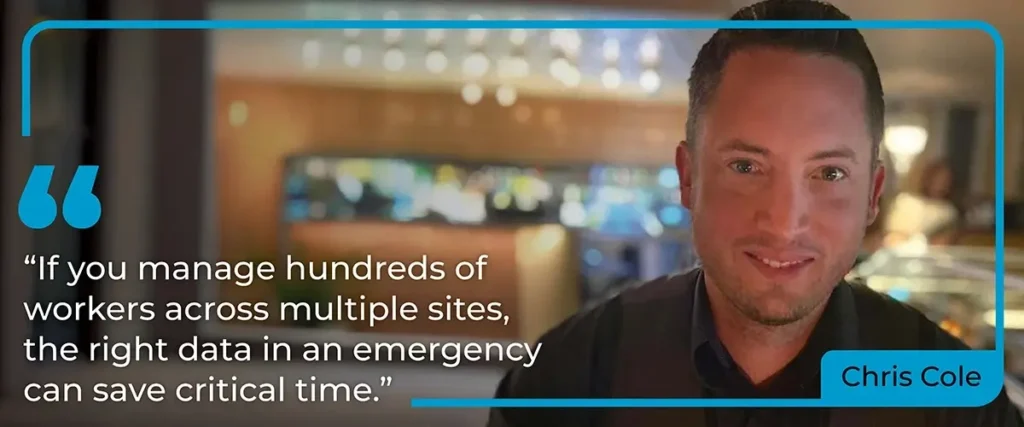
He described newer safety hard hats that can include optional GPS and emergency-access medical info. His interest is practical: if you manage hundreds of workers across multiple sites, the right data in an emergency can save critical time.
But he also draws a boundary: tech can support safety, but it cannot replace trust.
Why Chris’s Approach Works
Chris’s system is built around three principles that show up again in mature safety programs:
- Visibility beats paperwork. If you cannot see what’s happening across sites, you cannot lead it.
- Reporting requires psychological safety. If workers fear punishment, your data becomes fiction.
- Elimination beats reminders. The best control is the one that removes the hazard entirely.
The result is a safety program that scales, stays human, and doesn’t rely on perfect behavior to prevent incidents.
Related Articles

Discover Brian’s approach to workplace safety, from identifying hazards and documenting risks to building practical competence and learning from real-life...

Jason Ross of Bird Construction shares how a panic attack on a winter highway in northern Manitoba led him to...

Garrett Hill shares why crews take in the safety message once they know the person delivering it, and what ten...