
- Home
- Company Spotlights
- Josh Boychuk and the Psychology of Real Buy-In
Josh Boychuk and the Psychology of Real Buy-In
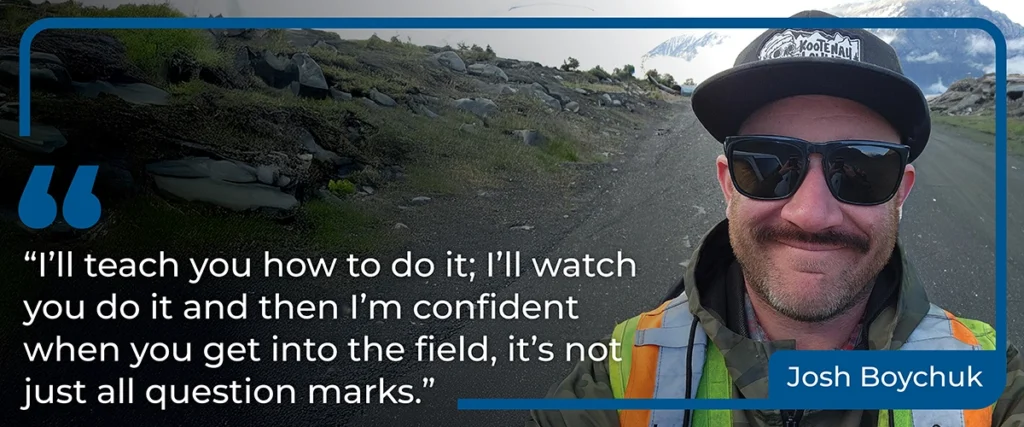
The first real cold snap in the Kootenays does not announce itself with a gentle flurry. It shows up like black ice on a shaded corner, glaring off fresh snow, and a long drive home when everybody is already running on fumes. In the field, those are the days when routine becomes risky, and when safety leadership either holds, or cracks.
Josh Boychuk, the Safety Manager at Nupqu, spoke to a truth we’ve witnessed across mining and resource work for years. Familiar tasks and written policies aren’t enough to guarantee safe performance. Safety is learned in motion. It’s taught, coached, verified, and reinforced until the right actions become second nature.
Josh’s story is not a polished corporate path. It is a practical one, built from remote camps, “cowboy” worksites, and a willingness to step into the messy middle where human behavior lives.
From “Cowboy Youth” to Calm, Consistent Safety Leadership
Josh spent 15 years as a mechanic before arthritis pushed him to rethink his future. He moved into the safety world through a field medic role, then into remote diamond drilling camps where heli access and shifting weather can trap crews for days. When evacuation is not guaranteed, risk tolerance changes fast.
That early experience taught him the value of planning, emergency response, and clear expectations. It also shaped his leadership style. He learnt that unsafe methods might feel faster in the moment, but they cost time, bodies, and trust in the long run. The focus became finding ways to work safely, efficiently, and without injury or property damage.
Today, Josh supports a diverse workforce at Nupqu, spanning forestry, environmental monitoring, archaeology, native plant nurseries, and GIS. That variety strengthens critical lessons. Safety culture cannot be generic. It has to make sense to the work people are doing that day, in that terrain, under those conditions.
Why Buy-In Is Not a Memo, It Is a Relationship
Josh called buy-in and accountability his biggest challenges, and that rings true for every high-risk industry. We can publish a perfect procedure and still watch it fail if the crew does not believe it is relevant, doable, and fair.
This is where psychology matters. People follow norms. They follow what they believe “people like us” do here. When safety becomes a once-a-month email, the social norm becomes ignoring it. When safety becomes a face-to-face conversation, a quick coaching moment, and a genuine “good job” after a solid hazard assessment, the norm shifts.
Josh uses repetition, but not the exhausting kind. He builds safety habits through human connection, recognition, short coaching sessions, and hands-on tutorials. He audits field-level hazard assessments, reinforces strong work, and occasionally adds small rewards. That is not fluffy. That is behavioral reinforcement, a cue, and reward that helps turn the right action into a habit.
If we have ever wondered why a crew will ignore a beautifully written bulletin but adopt a practice after one good in-person demo, this is the reason. Humans learn through doing things, and we remember what feels socially safe and practically useful.
Psychological Safety, the Invisible Control that Prevents Hidden Hazards
The minute workers fear safety, issues get hidden or unreported.
That is psychological safety in action. When people believe they will be punished, mocked, or shut down for speaking up, they go quiet. They stop sharing near misses. They stop flagging fatigue. They stop asking questions. The risk does not disappear, it just goes underground.
Josh works hard to avoid becoming the stereotype of the “white hat” who shows up to ruin the day. He aims for a neutral, credible middle ground. Not too lenient, not too heavy-handed. That balance is not a personality trait, it is a leadership control. It keeps the reporting channel open.

From Training to Real-World Competence
One recurring failure in safety systems is assuming competence. Training is often reduced to information transfer. One of Josh’s strongest messages was simple: we cannot assume people know how to do the work safely.
Josh’s approach emphasizes learning in context. New workers, especially those unfamiliar with industrial sites or winter driving, are paired with experienced staff through a Greenhand Gold hand model. This accelerates judgement-building by allowing new workers to observe, practice, and receive immediate feedback in real conditions.
He also runs short driver assessments and talks with people while they drive to evaluate hazard recognition, speed control, communication, and decision-making. That is applied to learning. We are not just asking people to repeat rules, we are asking them to analyze hazards, evaluate conditions, and apply safe choices while the task is happening.
The 360 Walk-around and the Psychology of Tiny Friction
Josh described a 360 walk-around as a quick loop around the vehicle every time someone is about to get in. In 15 to 20 seconds, they can catch low tires, leaks, obstacles, damage, or hazards they missed earlier.
This short pause catches low tires, leaks, obstacles, damage, or animals near the wheels. Psychologically, it disrupts automatic behavior and prompts deliberate attention before action. Most errors occur during transitions, rushing to move, leaving a task, starting the next one. The walk-around inserts tiny friction, a moment that forces attention before action.
Visual prompts placed on vehicle doors reinforce the habit. This removes reliance on memory and supports behavior through design, one of the most effective human factors of controls available.
Why Instructions Alone Don’t Control Risk
Josh shared a story from one blustery fall day, crews were installing sharp metal insulation roughly 90 feet above ground. The hazard was obvious. High wind plus unsecured material equals flying blades.
The controls were clear. Count what goes up. Strap it down. One piece at a time.
Urgency won. A piece came loose and landed near a worker below. No injury, but high potential.
This is where mature safety systems adapt. Instructions alone are not controlled. When risk is high and behaviour proves unreliable, verification becomes necessary. Photo confirmation of secured materials closed the gap between expectation and reality.
That is not micromanagement. That is risk-aligned control.
Planning for Regulatory Change
When occupational first aid requirements changed in British Columbia on November 1, 2024, many organizations scrambled. The rules were clear, but the training seats were not. Travel, certification timelines, and equipment upgrades create pressure.
Strong safety leadership responds with planning, not panic. Forecast training needs early. Reserve seats. Build compliance into onboarding instead of discovering gaps when a project is already live.
That mindset turns regulatory change into a manageable project instead of a crisis.
Fatigue, Permission, and Speaking Up Early
Josh describes fatigue as a seasonal threat, especially late in the shift and during darker months. His team updates hazard assessments throughout the day and uses paired work to catch fatigue early. They swap drivers. They take microbreaks. They treat fatigue as a hazard worth naming.
In B.C., WorkSafeBC states workers have the right to refuse unsafe work when they have reasonable cause to believe it puts them or others at risk. CCOHS notes that the right to refuse is intended for serious and imminent hazards and should follow the proper process.
That matters because a culture that supports refusal, or even a small course of corrections like swapping seats, is a culture that prevents incidents. When we make fatigue normal to report, we reduce the pressure to push through and hope.
What We Can Learn From Josh’s Approach
This style of safety leadership is not complicated, it is disciplined.
- We build buy-in through relationships, not broadcasts
- We treat training as practice, not a lecture
- We design prompts that support habits in the field
- We verify when risk and behavior demand it
- We stay ahead of regulatory change with planning, not panic
- We protect reporting by staying credible, fair, and consistent
That is what strong safety leadership looks like in the real world, especially in mining-adjacent work where weather, fatigue, and mixed experience levels collide.
Related Articles

Discover Brian’s approach to workplace safety, from identifying hazards and documenting risks to building practical competence and learning from real-life...

Jason Ross of Bird Construction shares how a panic attack on a winter highway in northern Manitoba led him to...

Garrett Hill shares why crews take in the safety message once they know the person delivering it, and what ten...