BIS Safety Software Canada

More Than Rules: Building Real Safety Relationships

Facebook
LinkedIn
Chelsea Shaver Spotlight Articles

That’s how Chelsea Shaver describes her unlikely path into safety. What started as a leap of faith by helping out family in construction, turned into a thriving consulting career. Today, she runs her own safety business, Juniper Safety Services, and partners with companies like Western Canadian Steel to strengthen safety culture from the ground up.

Why Real-World Relationships Matter

For Shaver, safety isn’t about paperwork or policing. It’s about people. 

“When you actually get to know someone, their kids, their weekend plans; they stop seeing you as ‘the safety cop’ and start seeing you as a person who cares,”  

Her psychology background helps her approach safety through human behavior. She doesn’t claim to be the expert in operating equipment. Instead, she treats workers as the experts in their trade, while she brings expertise in safety. “How can we meet in the middle?” she asks. That mindset builds trust and buy-in. 

Trial by Doubt: Earning Respect in a Male-Dominated Field

Shaver entered the industry at 22. Young. Female. And brand new. 

“Some guys didn’t want to listen. They’d tell me, ‘I’ve been doing this 30 years, I know better,’” she recalls 

The hardest part? Proving herself over time. She learned to keep showing up, keep listening, and not get discouraged. “You have to build trust before people see you as a professional. That doesn’t happen overnight.” 

Her advice for young women entering the field: keep going.  

Safety consultant Chelsea Shaver in a vest on-site, representing women in construction safety leadership.

“Don’t let the pushback demotivate you. Every confrontation, every dismissal, it’s just part of earning your spot.” 

Breakthrough on Site: A Culture Shift in Action

One of her proudest moments came after months of persistence with a reluctant crew. 

“At first, the guys would literally run away when I showed up,” she laughs. But slowly, things changed. One day, a worker who used to avoid her came running over, excited to report a small hazard he had spotted and fixed. 

“It wasn’t about the hazard itself. It was about him trusting me enough to bring it forward, and being proud of it,” she says 

That moment was proof: the culture had shifted. Workers weren’t afraid anymore. They felt heard. 

Lessons Learned: Not Everyone Will Like You

Safety work requires thick skin. 

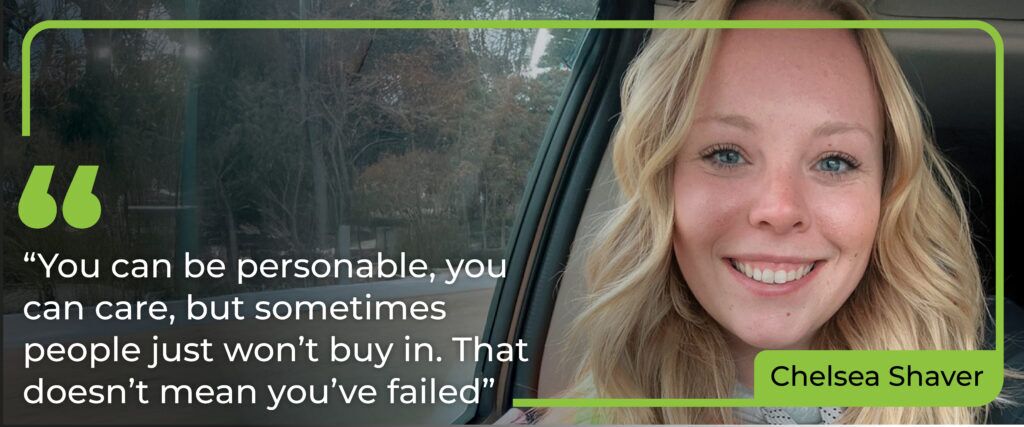
“Not everyone’s going to like you, and that’s okay,” Shaver says. “You can be personable, you can care, but sometimes people just won’t buy in. That doesn’t mean you’ve failed” 

Her philosophy: safety isn’t about popularity. It’s about persistence, professionalism, and creating space where workers feel safe to speak up. 

The Future of Safety: Digital First, Human Always

Looking ahead, Shaver sees digital tools as a game-changer. 

“Digital programs take away barriers. If someone struggles with handwriting or spelling, digital levels the field. It makes safety accessible,” she says 

She’s also watching AI with cautious optimism. “It’s huge, and honestly a bit overwhelming, but I think it can be beneficial, especially alongside more mandatory training courses.” 

Still, she believes technology can’t replace relationships. “At the end of the day, safety comes down to trust. No program or AI will ever change that.” 

Final Thoughts: Building Safety Through Influence

Chelsea Shaver knows safety isn’t about enforcing rules from the office. It’s about walking the site, asking questions, and listening. 

Her journey from babysitting to building safer workplaces shows that safety leadership isn’t defined by where you start, it’s defined by how you connect. 

“Workers just want to be heard,” she says. “If you give them a voice, they’ll give you their trust. And once you have that, real change happens.” 

Work smart  

Build trust 

Lead with heart