
- Home
- Company Spotlights
- How Curiosity, Connection, and Courage Shape a Safer Workforce
How Curiosity, Connection, and Courage Shape a Safer Workforce
Adam Thornton’s Mission to Turn Safety from a Rulebook into a Relationship
Some careers are chosen. Others are forged in moments that change everything.
For Adam Thornton, that moment came early in his career, when a serious workplace incident forced him to see safety in a new light. It stopped being a checklist and became a calling.
Today, more than 30 years later, Adam is a respected safety leader at Keyera who has worked across multiple sectors, including chemical manufacturing and oil and gas. He brings the same mindset to every role: learning the work, earning trust, and never losing sight of the people behind the process.
“You cannot protect someone’s life until you understand their work. The rules matter, but connection comes first.”
From the Field to the Frontline of Change
Adam began his career in operations in the early 1990s. When his company adopted global safety standards, he helped build policies and training from the ground up. It sparked something, a curiosity about how systems could make real work safer.
Then a serious incident occurred at his facility. That moment turned interest into conviction.
“I realized I did not want to just follow the rules, but I wanted to make them mean something.”
Since then, he has spent over 30 years protecting workforces in chemical manufacturing, EPC, and oil and gas, including the past six years in natural gas processing. This perspective exemplifies System Thinking phenomena, recognizing that safety is not about isolated components but about how organizational factors, workplace conditions, and human behaviors interact as a whole dynamic system. Adam learned early that safety cannot be fixed by addressing a single element. True improvement comes from understanding how the entire system functions together.

Where Culture Makes or Breaks Safety
Across Canada, Adam has seen safety culture at its best and its worst. In Alberta, open conversations about risk are common. But in some places, silence is still the norm.
“I have seen workers fired for speaking up. That is still happening. Culture makes the difference between compliance and courage.” These unfortunate circumstances align with what sociologist Diane Vaughan called the Normalization of Deviance. It is the insidious process where unsafe practices gradually become accepted as normal when they don’t immediately lead to disaster. Adam has witnessed firsthand, repeated shortcuts without consequences, and organizations drift toward failure while defending these methods as best practices. Once deviant behavior feels normal, people stop questioning it. That’s when we create risks instead of managing it.
His organization decided to take culture head-on by defining five core behaviors that guide every team. One of the most important things is having a questioning attitude.
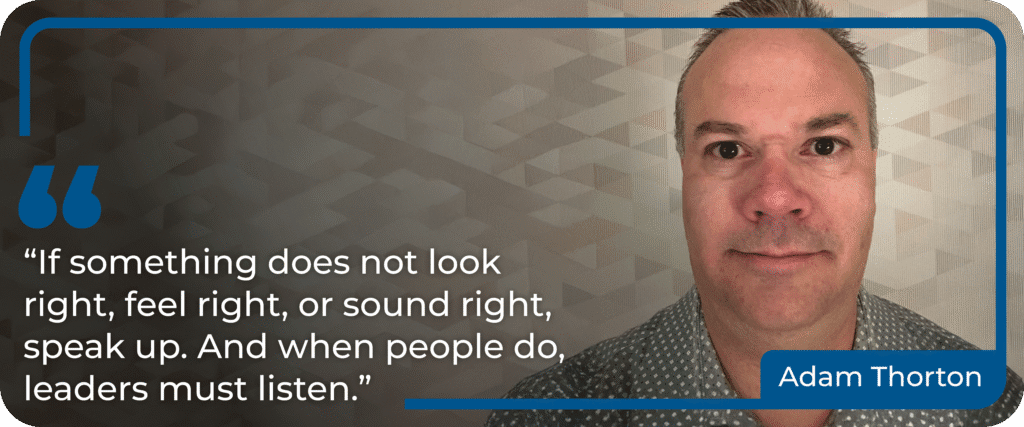
“If something does not look right, feel right, or sound right, speak up. And when people do, leaders must listen.”
Recognition became part of the process. Successes were shared. Leaders stopped rewarding shortcuts and started rewarding diligence.
“We made doing it right the win, not doing it fast.”
This is interesting because this change reflects principles from Social Identity Theory, where workers align their behavior with the groups they identify with. Adam’s team didn’t just change rules; they shaped workers’ sense of belonging, making safety excellence part of their collective identity rather than an imposed requirement.
Communication Is the Hardest Hazard to Control
In Adam’s world, safety conversations stretch across provinces, time zones, and sites hundreds of kilometers apart. Keeping messages consistent can feel like chasing echoes.
“It is easy for the message to twist as it moves. The only fix is being present.”
That is why Adam still spends time in the field, watching work, listening to workers, and closing the feedback loop.
His presence mitigates Proximity Bias, the cognitive tendency for leaders to unconsciously favor and remember those they see most often. In distributed workforces, remote workers can be overlooked or undervalued simply because they are not physically visible. By intentionally visiting all sites and maintaining consistent contact, Adam ensures every worker receives equal attention, and their safety concerns carry equal weight.
“People remember when you show up. They remember when you follow up. That is how trust starts.”
Advice for New Safety Professionals
Adam’s advice for anyone starting in safety is simple: lead with humility.
“Say, I am new, and I want to learn. People respect honesty and curiosity more than authority.”
He encourages new professionals to learn the work before enforcing the rules: to research independently, ask questions, and return to the field with insight, not ego. In safety reviews, it is important to consider decisions based on the information and context available at the time, rather than judging them by the outcomes. This approach supports fair analysis and effective system improvements.
“Safety is not about catching mistakes. It is about understanding people and helping them succeed.”
Integrity Above Everything
In high-risk industries such as H₂S, high pressure, confined spaces, and pipelines, Adam knows the stakes. But the hardest decisions, he says, are not technical hazards. They are about moral ones.
“If a project goes over budget, we can fix that. If we lose someone, we cannot.”
He has left organizations that compromise on ethics and refuses to trade safety for convenience.
“I would rather walk away from a job than walk away from my values.”
Technology Used with Thought
Adam embraces technology carefully.
Remote confined space monitoring has transformed oversight. AI-driven analytics have reduced reporting time dramatically. But technology is a tool, not a crutch.
“AI can show you data, but it cannot tell you what it means. That is still a human responsibility.”
He has also seen phones evolve from banned distractions to vital safety devices. Photos, inspections, and reports now happen in real time, safely and with purpose.
Safety Starts Where You Stand
For Adam, safety is deeply personal. His children are stepping into their own careers, and he wants them to enter workplaces built on respect, not fear.
“I want them working somewhere they can ask questions, where safety is not something to get through; it is something you live.”
Every day, he works toward that kind of culture, one where doing the right thing is second nature and speaking up is a sign of strength.
Because safety does not live in policies or programs; it lives in conversations, in courage, and in quiet moments when someone chooses to care enough to act.
Related Articles

Discover Brian’s approach to workplace safety, from identifying hazards and documenting risks to building practical competence and learning from real-life...

Jason Ross of Bird Construction shares how a panic attack on a winter highway in northern Manitoba led him to...

Garrett Hill shares why crews take in the safety message once they know the person delivering it, and what ten...