
- Home
- Company Spotlights
- Empowering Safety Through Leadership and Connection
Empowering Safety Through Leadership and Connection
How Melanie McGrath Transforms Workplace Safety from Compliance to Culture
Early in her career, Melanie McGrath discovered that zero incident reports do not always mean a workplace is truly safe. What many overlook is that real safety begins with psychological safety, when employees feel empowered to speak up without fear of punishment. That principle now sits at the centre of her leadership approach at CBCL, where she combines practical field experience with strategic insight.
“Safety is not just a rule. It’s about caring for the people you work with every day.”
As a seasoned legal and safety professional, Melanie applies her knowledge of governance and ethics in ways that support workplaces where safety is genuinely valued. Her approach is grounded in trust, connection, and proactive leadership, ensuring that safety goes beyond compliance alone.
The Science Behind Speaking Up
Here’s what people don’t commonly understand is employees sometimes hesitate to speak up due to psychological factors. For example, The Bystander Effect, shows why individuals remain silent when others are present, assuming someone else will act. Recognizing this allows Melanie to create an environment where everyone feels responsible to speak up.
In practice, this made a difference that on one project, a junior team member noticed a small but critical equipment issue. Because Melanie had built an environment of trust, the worker reported it immediately, preventing a potential accident. This experience showed that safety depends on a culture where proactive behavior is the norm, not just observation. Melanie’s approach focuses on building that culture, so safety persists even when no one is watching.
Another key factor is Heuristics, it explains about the mental shortcuts workers use to make quick decisions. While helpful, they can lead to dangerous oversimplifications. By understanding this, Melanie ensures procedures are clear and practical, helping teams make safer choices in real time.
Also noteworthy is Social Facilitation, which shows that people perform differently under observation, works better on simple tasks, worse on complex judgment calls. This means that while people follow protocols more consistently when observed, behavior can slip when supervision is absent. So, Melanie emphasizes that building a culture where employees genuinely care about safety is crucial, no procedure works if people don’t share concerns.
From Policy to Practice
Melanie shows that safety works best when policies become practical actions that people can use in the field. Instead of relying only on documentation, Melanie focuses on how procedures affect the people doing the work.
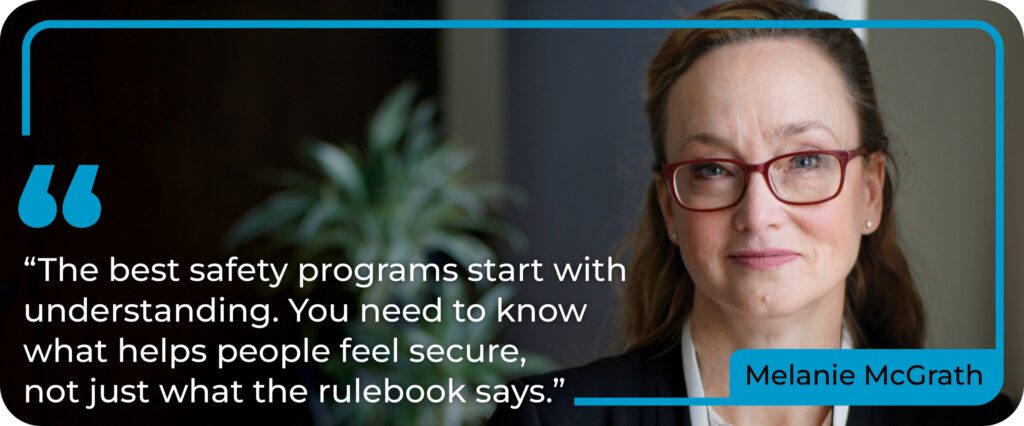
“The best safety programs start with understanding. You need to know what helps people feel secure, not just what the rulebook says,” she explains by connecting policies to real human needs, she makes safety both practical and respected
Practical Policies in Action
Melanie applies these principles in ways that make safety meaningful and usable for employees. She prioritizes hands-on approaches and real-life modeling to reinforce learning:
- Mentorship programs: Experienced staff guide new employees on safety best practices, creating continuous learning and helping them feel confident on the job.
- Hands-on training: Beyond checklists, employees practice emergency responses, hazard identification, and incident reporting in real scenarios to reinforce learning.
- Field-administration connection: Safety policies are integrated with daily operations, ensuring inspections, audits, and compliance reporting are practical and actionable, not just bureaucratic tasks.
- Human-centered policies: Initiatives consider psychological, social, and physical needs to get genuine engagement.
Communicating Safety Effectively
Interestingly, Melanie believes that safety improves when people talk to each other. She ensures safety conversations are regular and familiar, making them second nature. The idea here is that when employees communicate openly, risks are identified faster and collaboration improves.
“Even the best procedures fail if people don’t talk to each other. Safety is continuous communication, not a one-time message,” she explains. By encouraging open forums, knowledge-sharing, and leadership workshops, Melanie help teams learn from each other, spot risk early, turn safety into a shared responsibility that everyone can understand and act on.
Leading with Integrity
One aspect people don’t always recognize is that real safety leadership means making tough decisions that protect people in the long run. The interesting insight here is Melanie applies Cognitive Dissonance to understand the internal tension teams feel when safety conflicts with deadlines. Cognitive Dissonance, the mental discomfort caused by conflicting beliefs, explains why this takes courage. For example, when major deadlines loom and safety hazards emerge, teams face a choice between meeting goals and maintaining safety.
Instead of rationalizing the risk, Melanie chooses to halt operations, reinforcing that integrity outweighs convenience. “You must choose courage over comfort. Ignoring risks does more harm than good,” she advises. This demonstrates how integrity and safety leadership go hand in hand.
Safety Through Technology
It’s important to note that technology can enhance safety efforts, but only when used thoughtfully. Melanie uses digital tools, analytics, and remote platforms to improve monitoring and compliance while keeping the human factor central.
“Tech can help identify patterns, but it cannot replace human judgment. People are still the core of safety,” she explains. Her approach ensures that technology supports decision-making without losing the personal connection essential for a safe workplace.
Traits of Top Safety Leaders
Melanie identifies three key traits that make safety leaders effective:
- Curiosity: Always ask, “What can I learn?”
- Connection: Build trust before directing others.
- Conviction: Stand firm on what matters, even when it is difficult.
“Being a leader is not about having all the answers. It’s about creating space where questions are welcome and learning is continuous.”
Building a Safety-First Culture
Ultimately, Melanie envisions a culture where safety is a shared value, embedded in every role, and reinforced through daily actions.
“Safety is how we show care for colleagues, clients, and the community. It is lived, not just managed,” she explains.
By prioritizing respect, trust, and continuous improvement, Melanie demonstrates that safety leadership goes beyond rules. It protects lives, strengthens teams, and creates workplaces where everyone feels empowered to act safely.
Related Articles

Discover Brian’s approach to workplace safety, from identifying hazards and documenting risks to building practical competence and learning from real-life...
Jason Ross of Bird Construction shares how a panic attack on a winter highway in northern Manitoba led him to...
Garrett Hill shares why crews take in the safety message once they know the person delivering it, and what ten...