
- Accueil
- Présentations d'entreprises
- Graham Jackson veut que vous laissiez votre ego de côté
Une blessure qui a failli lui coûter la vie a appris au directeur de la santé et de la sécurité de SkyFire Energy à faire confiance à ses équipes plutôt qu'à son règlement.
« Je ne vous dis pas de faire ça parce que mon livre dit qu'il faut le faire de cette façon, Graham Jackson dit. C'est parce que je veux que vous rentriez chez vous sains et saufs à la fin de la journée. »
Graham Jackson est directeur de la santé et de la sécurité chez SkyFire Energy, l'un des plus importants entrepreneurs en énergie solaire de l'Ouest canadien. L'entreprise, détenue par ses employés, installe des systèmes solaires partout dans l'Ouest depuis 2001. Comme bien des bons professionnels de la sécurité, il est issu des métiers, pas d'une salle de classe. Il a grandi sur une ferme du sud de l'Alberta, a fait du rodéo et a fait ses débuts en charpenterie à seize ans, fabriquant des clôtures sur mesure tout en travaillant à l'obtention de sa carte de compétence. Il est aussi étonnamment ouvert au sujet de ce qui l'a mené vers la sécurité, et c'est un choix de sa part. « Je suis fier de mon histoire, dit-il. Ce n'est pas quelque chose dont j'ai honte. »
L'accident
En 2014, Graham Jackson était chargé de projet pour une entreprise de démolition. L'opérateur s'était déclaré malade, alors il a pris la relève pour garder le chantier en marche, découpant des portes d'accès dans une cage d'ascenseur et hissant des blocs de béton à l'aide d'un ancrage de 2 600 livres fixé au toit. L'ancrage s'est cisaillé en deux. Le béton lui est tombé dessus dans une cage d'escalier, où il n'y avait nulle part où se déplacer, et lui a coincé le bras.
Il a perdu environ 75 pour cent de l'usage de son bras droit. Les dommages étaient internes : une déchirure complète de ce que son chirurgien appelait « la boîte noire » du poignet, censée être indestructible et, une fois abîmée, irréparable. Ce qui a suivi a été, à certains égards, plus difficile que la blessure elle-même : près de trois ans sans salaire, treize appels avant que sa réclamation soit reconnue et une relation qui a volé en éclats sous la pression. Au terme de ce combat, il a failli mettre fin à ses jours. Ce qui l'a ramené, au tout dernier moment, c'est son jeune fils qui criait son nom. Il appelle le garçon son petit ange et dit que son fils ignore encore qu'il a sauvé la vie de son père. Il a passé des années en thérapie depuis, et il raconte tout cela aujourd'hui, délibérément, parce qu'il a vu à quelle vitesse une blessure au travail peut entraîner une personne vers le fond. C'est le moteur de tout le reste de ce qu'il fait. « Parce que moi, j'ai failli ne pas y arriver » : c'est ainsi qu'il a tendance à terminer toute phrase sur les raisons pour lesquelles il tient tant à cela.

Sur le terrain
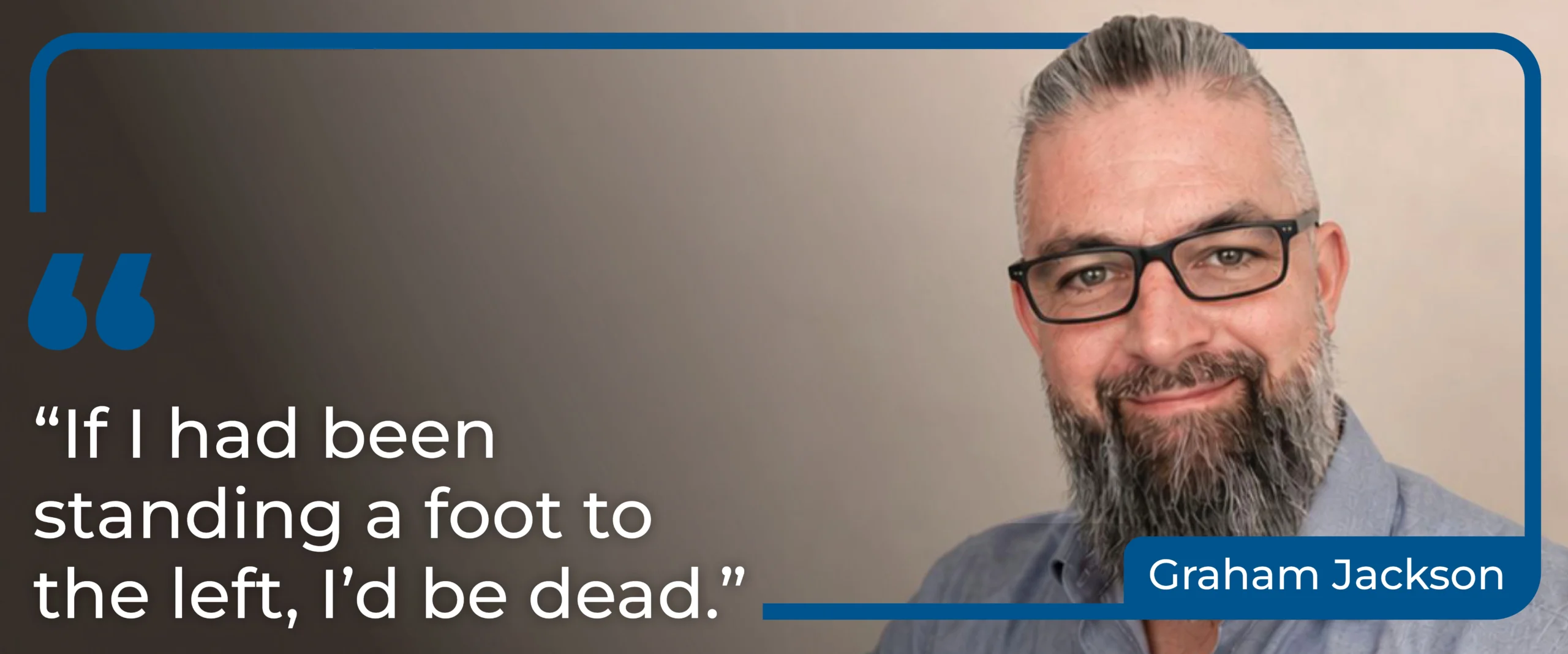
Le détail que Graham Jackson ne laisse jamais une équipe oublier, c'est que son accident n'était pas un accident insolite. « Ce n'était pas quelque chose d'inhabituel. Ce n'était pas quelque chose de dangereux », dit-il. Il travaillait dans le respect des règles, exécutant une tâche courante, un jour ordinaire. « Si je m'étais tenu à un pied vers la gauche, je serais mort. »
C'est pourquoi il passe ses journées sur le chantier plutôt que derrière un bureau. Avec une douzaine d'équipes déployées un jour donné, travaillant sous tension et en hauteur, il essaie de poser les yeux sur presque toutes, à l'affût des petites choses que l'expérience rend invisibles. Il affirme sans détour que la compétence ne protège pas contre le relâchement. Il voit « des personnes hautement qualifiées qui deviennent complaisantes », et lorsqu'il signale quelque chose, la réaction qu'il obtient le plus souvent est un merci discret et l'aveu qu'elles-mêmes avaient cessé de le remarquer.
Du miel, pas du vinaigre
La mission plus large de Graham Jackson est de faire disparaître un stéréotype. « Les professionnels de la sécurité sont généralement détestés, dit-il, et je veux me défaire de ce préjugé voulant qu'on soit là pour vous prendre en faute. » Il estime que le domaine a mérité une partie de cette réputation en misant sur l'autorité plutôt que sur la confiance, et sa solution n'est pas compliquée. « On attrape plus de mouches avec du miel qu'avec du vinaigre. » Il a un jour débattu pendant trois heures avec un professeur d'université pour savoir si un responsable de la sécurité peut être ami avec les travailleurs. Il croit toujours qu'il avait raison. Les règles ne plient pas, mais le ton, lui, peut plier. Oui, ça doit se faire de cette façon, « mais pas sur un ton menaçant ». Quand les équipes ont la conviction qu'il travaille dans leur intérêt plutôt que pour son cartable, elles cessent de redouter son arrivée sur le chantier et se mettent à l'accueillir.
La preuve dont il est le plus fier n'est pas un chiffre. SkyFire avait déjà les bons systèmes de sécurité en place, dit-il, et le travail a consisté à leur donner vie par le leadership, la constance et la mobilisation des employés. Ce qui a changé, c'est la culture. Aujourd'hui, il règne « un solide climat de confiance et de collaboration » avec le service de la santé et de la sécurité, et la sécurité est reconnue comme partie intégrante de la façon dont l'entreprise fonctionne.

Laissez votre ego de côté
Demandez à Graham Jackson ce qu'il dirait à son jeune lui, et la réponse vient sans hésiter : « Laisse ton ego de côté. » Il voit des gens sortir de l'école convaincus d'en savoir plus que les équipes qu'ils sont là pour protéger, et il était l'un d'eux. Il a obtenu son diplôme avec distinction, et il lui a quand même fallu ravaler son ego pour constater à quel point il en savait peu. Les gens sur le terrain, comme il le dit, sont les véritables experts du produit. « Ils savent tout ce qu'il y a à savoir sur ce qu'ils font. » Apprendre à écouter, à demander plutôt qu'à dicter, a été la chose la plus difficile qu'il ait eu à faire dans cette carrière.
Graham Jackson ne mène pas avec le règlement, parce qu'un règlement ne l'a pas sauvé et qu'il ne sauvera pas la personne devant lui. Ce qui pourrait la sauver, c'est un directeur de la santé et de la sécurité qui s'est lui-même retrouvé sous le béton et qui sait exactement ce que coûte un pied dans la mauvaise direction, un homme qui a décidé que le métier n'est pas fait pour être obéi, mais pour inspirer confiance.

